Saturday, October 06, 2007

Plastic Ban and Waste Management


The recent Plastic Ban (on carry bags less than 30 microns) by the Government of Kerala has evoked a mized response from the general public and traders. During my recent visit to Ekm, I thought that the ban was effective. When I went to a medical shop and bought some stuff including a packet of chips, the guy packed evrything in a paper bag and tied it with thread before giving it to me. But, more than a month later, there are reports say that all is not well. The report says several things, and stresses on lack of instruments to measure whether the bag is below 30 microns; and seems to suggest that some inspectors use the unavailability of instruments to ask for bribe. But, on the whole, the ban in Kerala seems to be much more effective than the one in Maharashtra in 2005 although efforts to beat the ban with an extra micron is not totally ineffective. A year after the Maharashtra ban, the media largely suggested that the ban was ineffective and that it even had negative consequences. Although there is a HC stay on the ban on plastic bags between 30 and 50 microns, the government is exploring methods to expand the ban to the 50 micron limit. This suggests that the ban is here to stay. A detailed report on the status of plastic waste management in India is available at the Central Pollution Control Board's Website.


To effectively get the ban to the masses and to ensure that the ban achieves the desired results, the government has to answer the following simple questions:


  1. Why only plastic carry bags? Why not other plastic items?


  2. What is the logic behind banning bags below a specific micron limit?


  3. Is there no effective way of recycling plastic waste? Cant we explore better recycling rather than banning plastic bags as they are very useful to the common man?


I am not sure whether the government has answered these questions effectively, and whether the media has played its part in getting the answers to the masses. I talked to some people while at Alappuzha, and none of them seem to understand the answer to the second question. And the third question, many people have taken for granted that plastic waste cannot be recycled effectively. I devote this post to aggregate various kinds of answers for the above questions.


(1). Other plastic items are as difficult to manage because of the not-easy-degradability. Such items include plastic tins and boxes too. Wikipedia says, "Plastics are durable and degrade very slowly. In some cases, burning plastic can release toxic fumes. Also, the manufacturing of plastics often creates large quantities of chemical pollutants." But, carrybags are considered to be a major problem because they rarely get reused and clog drains (This was the specific reason cited for the Maharashtra ban on plastics).


(2). As the problem with plastic bags is that of less reuse, one natural solution to the problem is to increase reuse. Thus, allowing usage of only thick plastic bags is naturally expected to enhance reuse.


(3). Now, the big question. Don't we have the technology to recycle plastics effectively? Or don't we have the technology to create degradable plastics? Although most people believe that the answer is "no", there are strong clues on the net which say that the answer is "yes". The rest of this post is devoted to summarizing the content on the web and from elsewhere about what alternative measures of plastic manufacturing and plastic waste management.


Novel Methods on Plastic Manufacturing and Plastic Waste Management


A. BioPlastics - Unlike the traditional plastics which are manufactured from petroleum, bioplastics are derived from plant sources such as hemp oil, soy bean oil and corn starch rather than traditional plastics which are derived from petroleum. This is generally regarded as a more sustainable activity, because it relies less on fossil fuel as a carbon source and also introduces less, net-new greenhouse emissions if it biodegrades. The Wikipedia article goes on to say "Because of their biological biodegradability, the use of bioplastics is especially popular in the packaging sector. The use of bioplastics for shopping bags is already very common. After their initial use they can be reused as bags for organic waste and then be composted. Trays and containers for fruit, vegetables, eggs and meat, bottles for soft drinks and dairy products and blister foils for fruit and vegetables are also already widely manufactured from bioplastics". I am not sure why bioplastics are not popular here. I must confess that I dont know whether bioplastics were "tried and tested" in our environment though.


B. Plastic Recycling - Alka Zadgaonkar: Alka Zadgaonkar claims that her's is the "world's first continuous process for all manner of waste plastics". Infact, although this seems like somebody's imagination, they have already implemented the technology. The article goes on to say "Alka and her husband Umesh, are buying in 5 tonnes of plastic waste everyday in Nagpur at prices attractive to rag pickers. They are making money right now, and are about to scale up and buy in 25 tonnes of plastic waste a day. That production too is booked. As Nagpur generates only 35 TPD of plastic waste, they will shortly run out of raw material to grow bigger." It is unfortunate that we, in Kerala, who claim to be very forward looking, are hardly paying attention to such efforts and to study how we can replicate such efforts in our own environment.


C. Plastic Recycling - Dr. RK Raina: An institute in Delhi has been conducting extensive research on plastic waste recycling and converting plastics to solid waste. Dr R K Raina says : ‘What we have done is to explore ways to improve upon the properties of plastic as fuel. We prepared different types of fuels by simply adding wastes like sawdust, waste paper, leaf, and coal dust. All the blended fuels showed marked improvements in ease of burning. This is because wastes help to increase the porosity of plastic that traps oxygen, helping it to burn’. A report says "The end product is a readily saleable fuel brick. The Institute says the process is so simple that villagers can recycle plastics by mixing them with bio wastes at 110 deg. C. and earn sizeable incomes".


D. Plastic Recycling - Jim Garthe: Jim Garthe, a professional engineer at Penn State University, has developed a technology to convert plastics to plastofuel nuggets. The report says: "About 9 years ago, he built a small table-top machine which would compact rudimentarily shred mixed plastic waste and extrude them into well compacted sausages. These are then sliced by a hot knife into 'Plastofuel' nuggets. The nuggets may then be stored forever and transported economically. Sizable markets are emerging for Plastofuel and other plastic derived fuels [PDF]. Cement and steel majors are conducting trials using plastic waste as fuel adjunct, with a view to reduce energy costs. Cement giant LaFarge North America, Pa has begun trial burning waste plastic as a fuel supplement. These trials are being conducted with a close eye on emissions. The company is keeping local people informed and involved ".


E. Plastic Waste for Laying Roads: There have been multiple efforts within India to use plastics for laying roads. I remember having seen a report on Indiavision or Manorama News which reported that the local people were satisfied with plastic roads in the area where it was tried out. The reporter said "Plastic Road ivdem vareyaanu lay cheythittullathu. Plastic Road ivde theerunnu, kundum kuzhiyum ivde muthal thudangunnu". Although I cannot find a link for the article, it seems that the plan reported earlier has materialized. Plastic roads have been tested elsewhere in TamilNadu too. An article which talks about the technology aspect says "One promising solution tp the problem is from Prof. R Vasudevan of Thiagarajar College of Engineering, Madurai. He thought up the idea of shredding plastic waste, mixing it with bitumen and using the polymerised mix in road construction. Chennai Corporation reacted with commendable speed. In Nov, 2002, it laid out a short stretch of road to test the idea. It has now declared itself satisfied with the trial. Chennai generates close to 150 tonnes of plastic waste everyday. If the Corporation buys, as it says it will, the plastic-waste-for-road-laying idea could be a win-win situation: better roads, money for the poor and cleaner environment. " Mr Ahmed Khan has achieved a lot of success using a similar technology.

The usage of plastics for laying roads has been utilized in Kerala too.


F. Street Lighting with Plastic Waste: There is a recent effort within our own state to explore BoT options of using plastic waste to operate street lights on a BoT basis, leaving considerable amount of the decision making process to the local governing bodies. The report says, "Kerala Builders Forum and Plastic Manufacturers Association have offered to set up a common plastic recycling facility in Kochi. ‘We’ll invest. And the revenue can be shared with Kudumbasree women self-help groups, who collect segregated houshold waste,’ says PJ Mathew, president of the association. ". This seems to be a very good step in this direction; lets hope it materializes.


G. Waste to EcoFriendly Products - Zero Waste Kovalam: The project on recycling waste at origin at Kovalam aims at recycling plastic bags and introducing more eco-friendly products. The solution for non-biodegradable includes creating Resource Recovery Parks. Although this project at Kovalam doesnt introduce any new technology, I include it as a separate bullet here as it has been widely cited.


H. Power Generation From Plastic Waste: Although it seems to be a very preliminary effort, the Local Administration Minister Paloli Muhammed Kutty recently hinted at plans on power generation from plastic waste. The report says "The State government is considering generation of electricity from plastic waste with German technical support. Talks are being held with two German companies, Local Administration Minister Paloli Mohammed Kutty said." I am not sure whether there are plans to link this to the efforts by Sajidas on Biotech which won the Green Oscar Award.


I. Plastic To Floor Tiles: There has been a recent news report about converting plastic to floor tiles. This is about a person by name Joy, in Thrissur, who has developed a technology to convert plastic to cheap floor tiles. The article says "Everyday the solid waste innovator from Thrissur collects plastic bags from a garbage dump, shreds them, and through a combination of simple procedures, uses them to make floor tiles. " Another report on the same person appears here. Such tiles cost just 12 Rs. as against Rs. 30 - which is the manufacturing cost for cement tiles.


Although the list above is - by no means - comprehensive, I hope that this list would serve to give a glimpse of plastic waste management efforts.


It may be noted that there are good avenues to display research efforts and results in the direction of plastic waste management. PlastIndia is a conference to be held in 2009 at New Delhi. Further, there was a recent conference focussed on plastic recycling early in 2007 also in India.


Wednesday, June 06, 2007

Going Green with "Ente Maram"

The World Environment Day is annually "celebrated" on June 5th. Celebrations include essay writing, pledges, poster competetions and the like. None of these end up having long lasting efforts. Its just another ocassion to get some political attention towards the burning environmental issues. But the World Environment Day of 2007 would be memorable to most school children in Kerala - This was because June 5 was chosen for the launch of the "Ente Maram Paddathy", the afforestation initiative by the ruling LDF in Kerala. It involves the planting of 25 lakh saplings by school children, and encouraging them to love the environment. I read somewhere that the LDF was targetting increasing forest cover from 24% to 33% over the next few years; although I am not sure about the exact figures, the government is certainly doing something in this regard.

Although "Ente Maram" is given enough popularity through newspapers, there is no official site maintained by the Government for the Project. Hence, I decided that I would blog about this collecting all information that is available from the web, mainly to ensure that pravasi malayalis do know about this fantastic initiative.

The project is a joint initiative by the Education Department and the Forest Department. One among the main motivations, as the Government puts it, is to have a green coastal belt to protect them against natural hazards such as Tsunamis (I am not sure about whether a green coastal belt would resist the Tsunami, but I heard that some Tsunami fund is being used for the Project). The project involves distribution of 25 lakh saplings of 24 species to selected 5095 schools all over the state to be planted by students in classes 5th-9th standard. Hindu says, "As many as 24.46 lakh saplings are to be planted in a single day, making it one of the most intensive afforestation programmes ever taken up."

The project was inauguarated by Medha Patkar by planting a sapling at a school in the State Capital in the presence of some ministers and Sugathakumari. Reports on the project appear here and here. Sadly, this was the only place in the government domain which speaks about the project.

The eviction drive, especially in Munnar where the encroachments were mostly on the forest area, along with such afforestation initiatives would definitely make some difference. It is encouraging to see that the Government is spending energy and money on such initiatives.

Monday, June 04, 2007

On Lotteries and Kerala

In 2005, when Oommen Chandy was the Chief Minister, there was a huge campaign against Online and Other-State Lotteries. If I recollect the incidents correctly, the Government first tried to ban online lotteries, and then tried to ban all the other-state lotteries. The move wasnt approved by the Supreme Court and thus, there were two options
  • Allow uncontrolled operation of lotteries in the state OR
  • To ban all lotteries

Quite obviously, the government thought that Option 2 was the way to go. And thus came the ban on lotteries in the state (Ref: Kerala Bans All Lotteries) in early 2005. I thought that it was a positive move (as lotteries promote the habit of speculative investment among the masses and hence has to be discouraged), and that the LDF and other organizations would welcome the decision. But, that was not what happened.

And there were reports on the Effects of the Lottery Ban

Indeed, some consequences of Lottery ban were bad, although expected. For instance, the Kerala State Lottery which had started in 1967 (under the EMS Government) had resulted in thousands of people (mostly handicapped people) earning their daily bread out of it. The concern was genuine, what would those people do? But, I expected that the LDF would have been more constructuve and would have come up with recommendations for alternative sources of employment to the handicapped.

Let me draw your attention once again to one of Achuthanandan's reasons for protesting against the lottery ban. That it causes an annual loss of 100s of crores to the Government. I can hardly think of a person like him talking in those lines. The customers of the Kerala State Lottery are mostly from the lower strata of the society, as those are the people who easily get attracted to these forms of gambling (I have seen long queues of autorickshaw drivers before the online lottery office at Edappally Toll). Let us assume that there are around 50 lakh people who buy lotteries. Thus, the government is in effect getting 200 rs extra from those people by getting them to indulge in gambling. Thus, for me, the lottery ban is a gain of 100 crores to the lottery buyers which include the autorickshaw drivers and the like (which infact, is a wonderful thing to happen).

And at last, the Kerala Lotteries resumed functioning :(

Let me draw your attention to what lotteries are, and what their effects are, on the society. Although the undesirable effects of lotteries are quite evident and obvious, I use three articles to pull information about lotteries from:

  • Wikipedia: A lottery is a popular form of gambling which involves the drawing of lots for a prize. Lotteries are most often run by governments or local states and are sometimes described as a regressive tax, since those most likely to buy tickets will typically be the less affluent members of a society. The astronomically high odds against winning have also led to the epithets of a "tax on stupidity", "math tax" or the oxymoron "voluntary tax" (playing the lottery is voluntary; taxes are not). They are intended to suggest that lotteries are governmental revenue-raising mechanisms that will attract only those consumers who fail to see that the game is a very bad deal. Indeed, the desire of lottery operators to guarantee themselves a profit requires that an average lottery ticket be worth substantially less than what it costs to buy. After taking into account the present value of the lottery prize as a single lump sum cash payment, the impact of any taxes that might apply, and the likelihood of having to share the prize with other winners, it is not uncommon to find that a ticket for a typical major lottery is worth less than one third of its purchase price.The fact that lotteries are commonly played leads to some contradictions against standard models of economic rationality. However, the expectations of some players may not be to win the game, but the thrill and indulgence in a fantasy of possibly becoming wealthy become the goal. Even ignoring the thrill factor, there is the theoretical possibility that the purchase of a lottery ticket could represent a gain in expected utility, even though it represents a loss in expected monetary value, thus making the purchase a rational decision. Insurance, for instance, represents negative expected monetary value but is not considered to be a tax on stupidity because it is generally believed to deliver positive expected utility to the individual.
  • Lenin on Lotteries: With their honeyed words they deceive the peasant in the same way as people are deceived by a lottery. I shall tell you what a lottery is. Let us suppose I have a cow, worth 50 rubles. I want to sell the cow by means of a lottery, so I offer everyone tickets at a ruble each. Everyone has a chance of getting the cow for one ruble! People are tempted and the rubles pour in. When I have collected a hundred rubles I proceed to draw the lottery: the one whose ticket is drawn gets the cow for a ruble, the others get nothing. Was the cow “cheap” for the people? No, it was very dear, because the total money they paid was double the value of the cow, because two persons (the one who ran the lottery and the one who won the cow) gained without doing any work, and gained at the expense of the ninety-nine who lost their money. Thus, those who say that lotteries are advantageous to the people are simply practising deceit on the people. Those who promise to deliver the peasants from poverty and want by means of co-operatives of every kind (societies for buying cheap and selling profitably), improved farming, banks, and all that sort of thing, are deceiving them in exactly the same way. Just as in a lottery where there is one winner and all the rest are losers, so it is with these things: one middle peasant may manage to get rich, but ninety-nine of his fellow peasants bend their backs all their lives, never escape from want, and even sink more deeply into poverty.
  • Truth About Gambling: Lottery is one of the most senseless and speculative "investments" on Earth. It promotes the spending of real money for a highly elusive product (the win). It is deceitful in that the real product delivered reportedly 14 million times to one (14,000,000:1) is FALSE HOPE. It encourages the diversion of capital from reasonable investment vehicles which yield reasonable returns to a senseless investment which reportedly has been mathematically calculated to yield a significant return only once out of every 14 million times. From a local economic point of view, it has a highly negative multiplier effect. It promotes a harmful practice: unwise investing. It uses miseducation to promise education: People are encouraged to participate in this "investment" fraud, and are then told that the money gained from such an "investment" will be used to "educate" them. Lottery siphons money from the community but provides neither a comparable good nor service in return. (An honest tax could better benefit the community and would be more sound in moral, economic and psychological character. A tax called a tax is an honest tax. A tax called a chance is a fraud). It promotes psychological instability by encouraging individuals to commit real, hard-earned assets to mostly unreal, highly improbable trade activities. To grant a fair return to all would kill the lottery. It lives and thrives by consuming the hard-earned resources of losers. Its very life depends on the losses of many. Its best customers must be losers. It robs so many to pay so few. If it is a tax it is an unfair tax because it succeeds only in collecting from the gullible. Its negative impact is doubled: 1. It (by siphoning funds) weakens the regular economy; and 2. It creates a wholly defective side economy. It's one of the worse budgeting lessons a child could ever be taught. It exploits the weak and seeks to weaken the strong. It destroys soundness.

Given all these effects of lotteries, the LDF can be expected to be "lottery-haters". But, what has been happening in Kerala is just the opposite. To cite a few examples,

  • EMS Government in 1967 started the Kerala State Lottery, which declares on its web page "Indiayil Aadyam, Ennum Munnil"
  • The LDF protested against the Lottery Ban by the UDF in 2005
  • The Kerala Sports Super Bumper was launched by the LDF in 2007 to mobilize 200 crores for infrastructural developments at the Grass-root levels of the state

How the Kerala State Lottery is presented to the people is another interesting thing to note:

  • Kerala State Lotteries webpage has the following text in it (It talks about development, the prize money, development, poverty and what not.. bah): Have you ever noticed a Lottery agent walking through the road with lottery tickets in his/her hand? Well we may not notice him/her at first. But think, he too plays his part in re-sourcing money for the development of roads, bridges, hospitals, schools and much more. Channelising ones money for the development of the state is the success behind the Department of Lotteries. More than that, it is the sole income-source for many a downtrodden public in the society. Today, with more than 35,000 authorised agents and over 100,000 retail sellers; spanning over 14 districts, it is a major benefactor to the development of the state, self-employment for the poor and the common, and poverty eradication. The lottery department gains importance in this context, with much opportunity in front of it to conquer. Its social commitment towards the poor and needy hasn’t brought down the amount of prize money it disburses. The department gives away lakhs of prizes a week, through its four weekly lotteries and through its six bumper lotteries.
  • Description about Kerala Lottery and it's history talks about alleviating poverty through lotteries!!!!
  • The Onam Bumper Lottery has its caption as: Aishwaryapoornamaaya Thiruvonathe Varavelkku, Onam Bumper Lotteryil Pankedukku!!!!

Hope we do start realizing soon that Lottery is an evil and that Kerala would become a Lottery-free state sometime soon.

Tuesday, May 29, 2007

Women and Sabarimala

"Temple reforms" is a hot topic these days, and the people and the government have been trying to get kshethrapraveshanam for the non-hindus. Thinking about discrimination by temples, the first thing that comes to mind would be Sabarimala; the most famous pilgrimage center in Kerala.

As we all know, there is gender discrimination in temples (against women). Sabarimala goes another step (backward) and says that it wont allow women aged between 10 and 50 to visit the shrine. I did a quick web search to try to understand the "logic" behind this issue and did a quick web search. This post is to share the info that I got from the pages that Google pointed me to.

The most interesting one is the countercurrents article by Raji Rajagopalan which can be found here. It has a list of "reasons" as to why Sabarimala disallows women. They are as follows:
  1. The eight kilometer trek to the temple along dense woods is arduous for women;
  2. Ayyappa is a bachelor God and his bachelorhood will be broken if he sees a woman;
  3. The forty-one-day penance for the pilgrimage, where one must live as abstemiously as a saint, cannot be undertaken by women - they are too weak for that;
  4. Men cohorts will be enticed to think bad thoughts if women joined them in their trek;
  5. Letting women into the temple will disrupt law and order;
  6. Women's menstrual blood will attract animals in the wild and jeopardize fellow travelers;
  7. Menstruation is a no-no for God.

If the bullets (1) & (2) are to be believed, women above 50 also should not be allowed. There are other temples which allow women, and thus even (5) is invalid. So, we are left with (3), (4), (6) and (7). Yes, and these are reasons that people speak of in the 21st century!!! In the most literate state of the country. But yes, people have questioned these reasons. (I was unaware of the incidents listed in Raji's posting, but I assume that they are true).

  • A mother of two ill children wanted to enter the temple; and she was *arrested* before reaching the sanctum and this ban was upheld by the Kerala High Court in 1990 !!!!
  • A bunch of women supposedly tried to enter the shrine in December 2002. And the Kerala HC ordered a probe to see how that happened !!!!!!!!

This Indiavarta article says that this is the only temple in India where women between 10 and 50 are not allowed. A blog entry that I found raises an important point. An extract from that blog is as follows:

  • Does the state (centre or state) give any funds to Sabarimala temple or the board? Is the government a board member? Is the government providing security at the temple?
    If they are - then it’s the taxpayer’s money that is going to support an institution that discriminates on the basis of sex. Against the constitution, isn’t it? Especially because it’s not a minorities institution. (I could be wrong here - but am venturing into murkier waters.) That, is not acceptable to me. Cut state funding. Make sure it becomes totally un-cool to go to a temple that is discriminatory.

Time for us to reconsider whether things happening around us are right. I hope that the second set of reforms, which, I believe, is due, would address all these issues.

Towards Temple Reforms, at last

It has been a big issue for ages. Kalamandalam Hyderali wasnt allowed entry to many temples, and Yesudas was never allowed to enter Guruvayoor and many other temples (although Harivarasanam in his voice is played at Sabarimala on a daily basis). I had always believed that temples and their authorities would have to embrace reforms some day or the other. The earlier the better. Every year, in Kerala, this issue keeps coming up. I had blogged on this a year or so back here and that was when the Srilankan delegation entered Guruvayoor and the "purification" exercise was undertaken.

Whether it be due to G. Sudhakaran, or due to Vayalar Ravi, we have started talking about this issue again. And it seems that something concrete would come out of it this time, hopefully. We are definitely inching towards the second temple entry proclamation.

At this juncture, shouldnt we start thinking about the temple reforms at large, rather than just the issue of temple entry to non-hindus. The temples of Kerala do not allow entry to women during "certain" periods, and do not allow women in the age bracket of 10-50 to enter Sabarimala. Even a 4-month old kid's urine is so bad that punyaham has to be performed. All these definitely sound primitive.

G Sudhakaran's words threatening to bring in legislation if the priests do not address the call for reform is definitely the way to go. "Adapt to the changing times voluntarily, or the Govt will see to it that it happens" - a brave move indeed.

My opinion is that the Govt should initiate the second set of reforms, of which the Temple reforms are just a part. Ban on Lotteries and many other things which I will write about later should be part of the second set of reforms.

Monday, November 20, 2006

A Cleaner City: Courtesy "Clean Kerala" Initiative?

I was going to Kochi after around 5 months, and one visible change was about the cleanliness. The city appeared to be a lot cleaner. In these 5 months, Chickun Guniya had come and gone, and the Clean Kerala initiative had resumed (after Chickun Guniya). And Malayala Manorama had started its own campaign on Shuchithva Keralam. Anyways, things appear to have changed a bit at least.

The musical walkway which used to stink earlier is now better. And so are many other places at Ekm. Please do post comments about the impact of the Clean Kerala campaign on Ernakulam, if you know details.


Tuesday, November 14, 2006

Gathering more Knowledge is nothing but inflating Ego and narrowing one's Vision, says Amritanandamayi !!!!!!

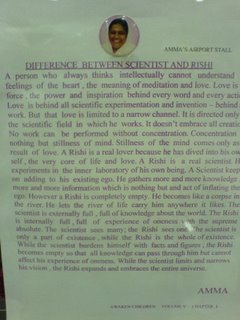
A scientist gathers more knowledge, thereby narrowing his vision and inflating his ego. Well, I am sure that you are thinking as to who would be so stupid to vomit such nonsense; it was none other than the revered Amritanandamayi of Kerala. Atleast thats what the note pasted proudly in front of the "Mata Amritanandamayi Muth" shop at the Nedumbassery Airport Shopping Arcade says.


Yes, now what you want is proof of that. And thats exactly what I have in the picture below (Taken using my fone cam). And for those who dont want to enlarge the image and read it, I paste the stuff below as well .


A person who always thinks intellectually cannot understand the feelings of the heart, the meaning of meditation and love. Love is the force, the power and inspiration behind every word and every action. Love is behind all scientific experimentation and invention - behind work. But that love is limited to a narrow channel. It is directed only to the scientific field in which he works. It doesn't embrace all crations. No work can be performed without concentration. Concentration is nothing but the stillness of mind. Stillness of the mind comes only as a result of love. A Rishi is a real lover because he has dived into his own self, the very core of life and love. A Rishi is a real scientist. He experiments in the inner laboratory of his own being. A scientist keeps on adding more to his existing ego. He gathers more and more knowledge and more and more information which is nothing but the act of inflating the ego. However a Rishi is completely empty. He becomes like a corpse in the river. He lets the river of life carry him anywhere it likes. The scientist is externally full, full of knowledge about the world. The Rishi is internally full, full of experience of oneness with the supreme absolute. The scientist sees many; the Rishi sees one. The scientist is only a part of existence, while the Rishi is the whole of existence. While the scientist burdens himself with facts and figures, the Rishi becomes empty so that all knowledge can pass through him but cannot affect his experience of oneness. While the scientist limits and narrows his vision, the Rishi expands and embraces the whole universe.
AMMA


So, this is what she believes. She believes that being empty is great. And she believes sthat scientists are narrow-minded creatures who are filled with ego and interested in nothing but inflating his/her ego. The message from "Amma" is loud and clear; gather no more knowledge because it inflates your ego and makes you narrow minded, do nothing and have an empty mind.

Wednesday, November 01, 2006

Malayalam Machine Transation: How Long Should We Wait?

Machine Translation is an active area of research, esp. in the Indian context. Machine translation technologies are those that convert text from one language to another. For instance, Google Translate is one system for Machine Translation.

Its a sad fact that we dont have any ongoing efforts towards building a English-Malayalam Machine Translation system (to the best of my knowledge, and I believe that I have done enough Googling to confrim the assertion). Such a system could play a big role in bridging the gap and to enable the common Keralite to keep abreast of the recent technical advancements by providing him an interface to the Web in his own language.

This post is to implicitly show how much we lag behind as compared to the other states in India regarding MT, and to provide a set of links which would possibly ease the literature survey part (and possibly, other parts too) of an effort to build a machine translation system for malayalam.

Disclaimer: I am no expert in machine translation or even the broader area of language technologies, but am one who would like to see an english to malayalam machine translation system in the near future.

Possible Impacts and Application Areas of an English to Malayalam Machine Translation System

  1. An english to malayalam machine translation system embedded in an email client would enable conversion of english mails to malayalam, which could be read out to the user by a text-to-speech system (there are various efforts on building text-to-speech conversion systems in various organizations in Kerala, the most notable one being the efforts at C-DIT, Thiruvananthapuram)
  2. A browser plugin would enable automatic conversion of the displayed web page to malayalam. This would open up the english content in the web (which as is obvious is fairly large) to almost all Keralites (as we have a high literacy rate, we could assume that almost evrybody would be able to read Malayalam)

Workshops/Conferences/Associations/Research Centers/Resources on Related Topics (Not comprehensive) - The more useful links are starred

  1. **A good overview of the various Indian Machine Translation efforts in India appears as a ppt at http://www.au-kbc.org/dfki/igws/Machine_Translation.ppt (I would say that going thru this one would give a good overview of the state of the art)
  2. Language Technologies Research Center, IIIT Hyderabad http://ltrc.iiit.net/showfile.php?filename=research/
  3. Modeling and Shallow Parsing of Indian Languages, Workshop in 2006 at IIT Bombay http://www.cfilt.iitb.ac.in/~mspil-06/ A paper on Malayalam handful of papers on Malayalam appeared there. See http://www.cfilt.iitb.ac.in/~mspil-06/id25.htm
  4. Natural Language Processing Association, India http://nlpai.iiit.ac.in/
  5. **Shakti-MT Kit: A tool for rapidly producing machine translation toolkits in Indian Languages, http://shakti.iiit.net/ (This system has already been used by a Chennai group to build an MT system from English to their Language)
  6. R.M.K. Sinha, `A Sanskrit based Word-expert model for machine translation among Indian languages',. http://ieeexplore.ieee.org/iel5/8421/26537/01182306.pdf
  7. Technology Development for Indian Languages - Department of IT, Goverment of India has a page on Indian Language Processing Resources at http://tdil.mit.gov.in/corpora/ach-corpora.htm
  8. C-DIT, Thiruvananthapuram has a Computational Linguistics Group who have built a Machine Translation System for the Hindi-Malayalam pair http://www.cdit.org/computionallinguistic.htm
  9. Prof. RMK Sinha at IIT Kanpur has been leading the effort at IIT Kanpur. A brief history of IIT Kanpur research on the same appears at http://www.cse.iitk.ac.in/users/langtech/hist.htm This includes details about the early 90s Anglabharathi System for the same
  10. Prof. Pushpak Bhattacharya has been leading the efforts at IIT Bombay. His homepage is at http://www.cse.iitb.ac.in/~pb/
  11. State and Role of Machine Translation in India - Article http://www.bcs-mt.org.uk/mtreview/11/mtr-11-10.htm
  12. Machine Translation set for Quantum Leap in India - Article http://www.cse.iitb.ac.in/~pb/indtrend2.htm
  13. Gyannidhi: A parallel corpus for Indian Languages http://www.cdacnoida.in/technicalpapers/PaperNepal.pdf
  14. Indian Language Corpora from the Central Institute of Indian Langauges - http://www.ciilcorpora.net/
  15. Statistical natural language processing and corpus-based computational linguistics: An annotated list of resources - NLP Group at the Stanford University - http://nlp.stanford.edu/links/statnlp.html
  16. STRANS 2001/2 - Symposium on Translation Support Systems - http://www.cse.iitk.ac.in/users/langtech/strans2002/index2002.htm An anaphora resolution system for malayalam is described in one of the papers ("Vasisht"-An anaphora resolution system for Malayalam and Hindi , Sobha L. and B.N.Patnaik, M.G.University Kottayam )
  17. ICON - International Conference on Natural Language Processing is a yearly event hosted in India ICON 2007 home is at http://www.iiit.net/icon2007/
  18. IJCAI 2007 Workshop on Cross-Lingual Information Access http://www.iiit.ac.in/CLIA2007
  19. IJCAI 2007 Workshop on Shallow Parsing in South Asian Languages http://shiva.iiit.ac.in/SPSAL2007/

According to what I understand, there are two possible approaches for Machine Translation

  • Rule-Based: It involves using the knowledge about the two languages and coming up with a set of rules for translation. This may involve (shallow) parsing to some extent as well. The quality is limited by the quality of the language knowledge
  • Statistical: This is the more recent and popular method of using aligned parallel corpora (i.e., for a A-B pair, it would need to have documents in A and the corresponding documents in B), but may be more extendable to similar language pairs as compared to the Rule-Based Approach. A good resource (including tutorials for download) appear at http://www.statmt.org/

The information posted above is limited to my knowledge of the subject (which is pretty low since I have never worked on language technologies). But, hope that this post provides a good resource which hopefully will aid efforts in the development of Malayalam machine translation systems (atleast in the initial stages).

Some expertise in this area (in the Malayalam context) rests with the Computational Linguistics Group at C-DIT Thiruvananthapuram. Infact, I believe that any effort in this direction has to be co-ordinated with the efforts at organizations like the below to get visibility

  1. C-DIT Thiruvananthapuram http://www.cdit.org/
  2. OSSICS http://www.ossics.com/

If any of the readers know of any efforts in this direction, kindly feel free to add the links to them in comments to this post.

Friday, June 09, 2006

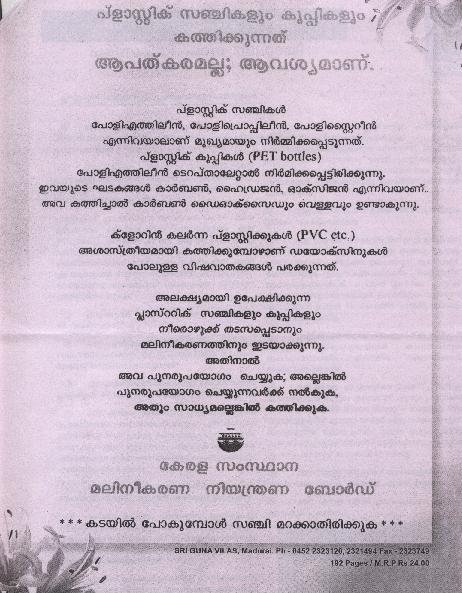
Burn Plastics !!!


It been a loong time since the last post. Wanted to resume with a good and well-written post, but nothing could stop me from posting the above image. And yes, it is definitely very weird

Sunday, April 23, 2006

Franke on Environmental Sress and Democratic Initiatives in Kerala

Well, I dont think anybody would forget the person. Richard W Franke is his name. He is releasing a book on Kerala (to add on to his other books on various aspects of Kerala).

Here are the details
Title: STRIVING FOR SUSTAINABILITY: ENVIRONMENTAL STRESS AND DEMOCRATIC INITIATIVES IN KERALA
Authors: SRIKUMAR CHATTOPADHYAY & RICHARD W. FRANKE
Page: http://www.chss.montclair.edu/anthro/strivingforsustainability.htm

For those who dont know Franke, he has a homepage here and his collection of links on kerala can be found here

Looking forward to the release of the book (just as you).

Kerala - A model of Economic Equality (Web Article)

I happened to see a very interesting article on "Too Much" (A commentary on Excess and Inequality). It talks about all things which we boast, but is a very unbiased commentary. It talks about how Kerala has failed in attracting capital for large projects, but has survived through redistribution.

As weblinks often die pretty soon, I post the entire text of the article at http://www.cipa-apex.org/toomuch/articlenew2006/March6a.html here. Highlighted are portions of the commentary which are significant, according to me.

------------------------------
An India Americans Seldom See
Economic growth isn't doing much to help average Indians. Economic equality could. So suggests the past quarter century of history in Kerala, India's most equal state.

Indian Finance Minister Palaniappan Chidambaram says the new budget he unveiled last week will help fix all this, by promoting economic growth. “I believe that growth is the best antidote to poverty,"the Harvard-trained Chidambaram proclaimed.
But economic growth, counters Delhi University political scientist Neera Chandhoke, ''does not necessarily lead to social development." What does?

The experience of one state within India suggests an answer. That state, Kerala, has conquered disease and poverty — and illiteracy and discrimination against women and girls — better than any state in India. And the secret to Kerala's success? Equality. Kerala has done more to share income and wealth fairly and widely than any other state within India.

Kerala, by every conventional measure of economic growth, rates as a poor place. Until recently, Keralans averaged less gross domestic product per person than the Indian average. The comforts conventional economic growth delivers — cars, air conditioners, washing machines — grace only a small percentage of Keralan households.

But on the only measure that “ultimately matters” — “the nature of the lives people can or cannot lead,” a formulation introduced by Nobel Prize-winning economist Amartya Sen — Keralans have created a society that outperforms much of the rest of the world. People in Kerala lead lives that are long and healthy, in vital, safe, tolerant communities.

The numbers document Kerala’s achievement. Morocco, a nation about equal to Kerala in population, generates about three times more wealth per person than Kerala. But people in Kerala, on average, live ten years longer than Moroccans. Colombia, another similarly sized nation, generates four times Kerala’s wealth. But babies die in Kerala at less than half the rate they die in Colombia.

Kerala and California also carry about the same population. California, of course, overwhelms Kerala economically. California generates seventy-three times more growth per person than Kerala’s. But Kerala, not California, enjoys more social peace. In the 1990s, about two hundred thousand inmates packed California’s jails and prisons. The number of full-time prisoners in Kerala: five thousand.

Within India, Kerala boasts the lowest rates of malaria and cholera and the highest rates of access to doctors, nurses, health clinics, and hospitals. Within the world, Kerala boasts a literacy rate that tops the average of all other low-income nations — by an amazing 40 percent.

And the literate in Kerala, unlike most of the rest of the low-income world, include girls as well as boys. In 1994, 93 percent of high school-age girls in Kerala were enrolled in high school, more than three times the rate in the rest of India and the world’s poor nations.

The people of Kerala owe their good fortune, their outstanding quality of life, partly to the accidents of geography. On the west, Kerala stretches along the Indian Ocean. This long coastline has always left Kerala open to new ideas from abroad, everything from Christianity to communism.

Meanwhile, on the east, mountain ranges have kept Kerala somewhat separate from the rest of the South Asian subcontinent. These mountains, together with the sea, helped create a land where divergent peoples — Hindus, Christians, Muslims, and Jews — have lived side by side, in tolerance, for generations.

In this heady atmosphere, intolerance — and exploitation — would not go unchallenged. In the nineteenth century, Kerala saw massive protests against the indignities of India’s caste system, an outrageously rigid hierarchy that subjected people in the “lower orders” to life-long humiliation.

In the 1930s, inspired by the teachings of Mahatma Gandhi, small but significant numbers of Kerala’s wealthy Brahmins, all born at the opposite end of the caste hierarchy, began “renouncing their privileges and giving up their lands.”

About the same time, all across Kerala, grassroot networks of landless tenants were organizing for thorough-going land reform. They would later elect, in 1957, India’s first communist-led state government, and this new government would quickly enact sweeping land reform legislation.

But the legislation would not go into effect. India’s central government promptly dismissed the ministers who would have been responsible for its implementation. Kerala’s peasant associations would not be intimidated. They kept up the pressure, and comprehensive land reform would finally come about, fourteen years later, in 1971. The reform would give about 1.5 million former tenant families title to their first property.

Over the next two decades, under steady pressure from peasant groups and trade unions, elected governments in Kerala, communist and noncommunist alike, would enact still more wealth-redistributing reforms.

Kerala’s minimum wage became India’s highest. Stiff tax rates on the wealthy, meanwhile, helped underwrite the free and low-cost distribution of basic services. Keralans, by the 1990s, were paying no charge for a minimal level of electrical power. In state-supported stores, Keralans could buy everything from rice to batteries at subsidized prices.

All these reforms, notes environmental author Bill McKibben, helped create “a state with some of the most equal wealth distribution on Earth.” (Read this in tune with this)That suited average families in Kerala quite nicely. But outsiders, particularly outsiders with power and wealth, considered Kerala hostile territory.

Industrialists avoided Kerala. They were not about to situate manufacturing plants in a state where wage rates ran three times the Indian average. Kerala, as a result, would not — could not — “grow” in standard economic terms. Without capital to fund ambitious “growth” projects, no giant manufacturing plants would soar above Kerala’s tropical forests.

Joblessness, on the other hand, would rise, to levels that topped the average unemployment rates elsewhere in India. But Kerala did not crumble, as conventional growth economics would have predicted. Kerala, instead, developed. Kerala’s left leaders may “have failed to spur economic growth,” as a 1998 Atlantic Monthly analysis would observe, but “they have been singularly successful at implementing development through redistribution.”

Indeed, between 1973-74 and century's end, only three states in India registered significant decreases in the percentage of their people living in poverty. Kerala led the way, with a poverty rate plunge from 60 percent in the early 1970s to 13 percent by the year 2000. Over those years, poverty rates in Kerala fell over twice as fast as poverty rates in India overall.

So which way for India in the future? India — and the world — might want to study Kerala's recent past.
---------------------------------------

Although this article suggests a lot of things, it conveniently ignores discussing about a lot of things
-> That joblessness isnt an economic problem, but more of a social problem (Money flows in from outside)
-> How long can "development through redistribution" last? Is it a model that can stand the test of time?
-> How much was the gulf money involved in the poverty rate plunge from 60% to 13%

Well, the author had no reason to discuss these issues, but then, never had any strong reason to avoid these things too.

But yes, Kerala Economic Equality model has been a success till now and we can still continue to boast. But this presents an entirely different picture. Mebbe, we have reached a point, where we have to seriously think about many issues. One thing that evrybody would perhaps agree would be that, we would like to retain the first place in terms of Economic Equality.

Non-Hindus and Temple Entry

Of late, we had this controversy on Sri Lankan Prime Minister Rajapaksha's visit to the Guruvayoor temple. Mrs. Rajapaksha was (supposedly) a Christian before marriage and hence, the authorities discovered (after 20-odd days were past after the visit) that there was a grevious crime that has been committed. They were thinking of having 20 days of Pooja after a shuddhikalasham (or something of that sort) and so on and so forth. I dont know what actually happened after that.

This sort of a thing asks us to rethink. We have been boasting of being very highly developed socially, and also that we are among the most secular states in India.

For instance, some other things that have happened have a connection to this
1-> Yesudas wasnt allowed to enter Guruvayoor temple, and hence had to sing outside
2-> Kalamandalam Hyderali wasnt allowed into many temples, although a few allowed him inside.

I somehow feel that the rule "non-hindus should not enter temples" is extremely communal and barbaric. The common excuse given is that "non-hindus" may not follow the usual practices such as bathe before going to a temple and so on. But well, if that be the reason, why not put such things explicitly; why a communal tinge to in the niyamam. I know people who are "non-hindus" but believe in offering prayers at any place of worship; and interestingly, they frequent temples too although they know that they are committing an offence. Whatever be the reason, denying entry to Yesudas seems like going back a couple of centuries.

Friday, April 21, 2006

Academia Industry Interaction - On the Search for Viable Models for Engineering Colleges in Kerala

We had this discussion on academia-industry interaction in Kerala going on in a yahoo group of which I am a member and which includes some of the best visionaries involved in academia/administration that Kerala has ever produced. Below is the mail that I posted to that group, and which includes a good (non-comprehensive) summary of industry-academia relationships in more famous T-schools in India

-------------------------------------------------

Let me introduce myself as a graduate (MTech) student in the Department of CS&E, IIT Madras. I have always felt that Computer Science departments have opened up newer ways of industry interaction, which largely benefits the academia rather than the industry. Let me use this mail to list down the ways of industry interaction practised (and those not practised) by CSE @ IITM (and possibly, CSE across IITs) so that people could comment on what kind of interaction could be worked out in academia in Kerala.

Here, many of the labs have projects which are either sponsored by ISRO or that are being done by the ISRO (and such governmental organisations). This, I feel, is the kind of industry interaction which has been practised for years in Indian academia. For instance, I happened to talk to a faculty member from Sri Chithra Institute (Tvpm - http://www.sctimst.ac.in) and he said that industry interaction at his institute if mostly by means of collaborative and funded projects. I may be wrong in generalising, but i feel this to be the conventional mode of industry interaction.

With the coming of private MNC giants into India, CS&E departments have been finding out ways of getting those people involved. Some of the kinds of interactions happening in CSE, IITM (many of them may exist in other departments as well) include

1-> External Registration Programmes - Industry people coming into the department for external registration programmes. These are similar to the part-time BTechs in Kerala, but for the fact that these external registration programmes in here are mainly for research. For instance, a person working with IBM Research can register for an External PhD (with two advisors - one from the institute and another from the organization), spend a couple of semesters at the institute and then do the rest of the research work in his organisation. This happens for PhD and MS programmes.

2-> Industry Visitors - Most of profs in here keep in good touch with their amunini working in various places. So when they come to India, they inevitably mail their old advisor regarding this, and the latter invites them to give a lecture. There have been lectures where people describe their research (redo the presentation of their most recently published research work) or rather just talk about their organization and it's larger vision. This happens very often.

3-> Collaborative Projects - Many profs in here work as consultants for various projects in the industry. For instance, one of our profs works with a team in Intel (and makes frequent visits to their place) whereas another is the main member of the crypto group @ Microsoft Research India. Microsoft Research India infact has a lot of such people, who infact have a designation at the Microsoft Research in addition to their faculty position at their institute. Collaborative projects involve the usual procedure of signing an MoU, but most of them are very exploratory in nature.

4-> Industry Visits - Something reverse to 2 also happens. Like, for instance, while I was dong my internship last year with IBM Research, there were a couple of profs from IIT Bombay who visited IBM Research to deliver lectures. Those things happened because those guys had their students working in IBM Research.

5-> Internships - It goes without saying that internships are an inevitable part of industry-academia relationships. Here we have a 3 month summer vacation, wherein students go in for internships. Academia in Kerala work more of less haphazardly and hence, the dates of the vacations are not very predictable. I badly wanted to do an internship while doing my BTech @ Model Engineering College, but that did not materialize because I couldnt give the industry people a guarantee that I would be available for 2 months at a stretch (the exam timetable was uncertain and is usually prepared by the university in the last minute)

6-> Courses Offered by Industry people - This has not yet materialized in IIT Madras. IITM plans to build something called a research park wherein plug-n-play space would be leased out to companies. As per the draft formulation, companies setting up office in the research park would have to offer courses (read subjects) @ IIT Madras for which they would be given credits and a minimum amount of credits have to be earned if the company wants to retain its office space in the research park. I know that there are guys in IBM Research (New Delhi) who offer courses in IIT Delhi. Further, I heard that Oracle had offered a full semester course in some college in Bangalore. Our academic setting, where there is little flexibility in the curriculum doesnt allow for such a thing to happen. I guess, we should introduce more electives and let colleges propose electives according to the faculty (industry or academia) available at that time

7-> Industry Grants and Awards for Faculty/Student Conference Travel - This is something that is motivated by the strong urge on the part of the industry to maintain a good relationship with the academia. As elsewhere, profs here get an international conference travel support only once in 3 years. But they actually travel much more frequently, partly due to project funding, and partly due to Industry grants. For instance, IBM provides a funding of 2 lakhs every year to the department for conference travel, which can be administered internally by the department. Further, Microsoft has supposedly sent a huge sum for the first time to the institute just like the IBM funding. Further, IBM, Google, and Microsoft provide travel awards to students getting papers accepted in prestegious international conferences.

8-> An Incubation Center - I personally know that IIT Delhi incubation center enabled the formation of very good start-ups in recent years with very good co-operation from the industry. I am not quite sure whether it is due to an incubation center, but have heard that a company called GDA Tech works within the campus of the Rajagiri Engineering College in Kakkanad, Ekm.

9->Marketing style Initiatives from the Industry - Although not very prevlent in IITs, some product companies offer free licenses and to their costly products (which is commonly opposed by the intellectuals by the argument that the aim is to brainwash the students to believe that their products are better). Further, apart from giving free licenses, they also give free training to use the product. Some companies organise workshops (which are actually training programmes) to popularise the technology or product that they use. For instance, we had the wireless communication giant, Qualcomm, organise a CDMA workshop in IIT Madras a couple of months back. Of the various kinds of industry-academia interactions, I feel that this is the only one, which can be argued against meaningfully. But yet, the students get to use industry-standard products and this may be of help to reduce the strength of the allegation that academia seldom works with real problems/systems

I dont know whether all these things listed above already exist in Kerala academia. I strongly feel that we should have
1-> A more or less stable academic calendar which enables students to plan their internships
2-> A flexible curriculum with a lot more elective courses
3-> A good alumini interaction (technical interaction) wherein any alumini would be able to come the department and deliver a lecture if he wants to convey something worthwhile. In my college, (Model Engineering College), industry lectures were so rare that when there was one, everybody rushed in as if to see something new happening. I guess industry lectures should become the order of the day. Profs who have friends in the industry should invite them frequently to make the students aware of the current trends in the industry.
4-> Opportunity to do research as a part of their BTech project. When I wanted to do some research as a part of my BTech project, people were looking at me as if i am doing some outrageous activity (and as if i am very eccentric) 5-> An incubation center per a cluster of colleges.

I would very much like people to comment on which among the above are viable in our academic setting as of now. If so, could **** (with the help of its highly influential people such as *** and ********) do something that could make a difference.

Best Regards
Deepak

---------------------------------------

Tuesday, April 18, 2006

Science and Technology Research Centers in Kerala

We have a lot of S&T research centers in the state.. (it may be noted that only one of them is an engineering research center in the conventional or IT-related engineering disciplines).. i thought i would create a list of them and here it is..

It may be noted here that most of the Research centers perform far better than university departments. Care has been taken to include only those institutes which have established their place in the global research scene of the area in which they specialise in.

Disclaimer: This list is by no means exhaustive. The listing is in no particular order.

Request: If you know of any other research institute in Kerala, please do post it as a comment. I would like to make this list comprehensive as time goes by.

1. Regional Research Laboratory, Thiruvananthapuram
Areas of Research: Agroprocessing and Natural Products, Biotechnology, Chemical Sciences and Technologies, Materials and Minerals, Process Engineering and Environmental Technology
Home: http://w3rrlt.csir.res.in/

2. Tropical Botanical Garden and Research Institute, Thiruvananthapuram
Home: http://www.tbgri.org/

3. Center for Earth Science Studies, Akkulam, Thiruvananthapuram
Areas of Research: Natural Hazards Management, Earth Science Studies
Home: http://www.cessind.org/

4. Rajeev Gandhi Center for Biotechnology, Poojappura, Thiruvananthapuram
Areas of Research: Animal Biotechnology, Cancer Biology, Environmental Biotechnology, Human Molecular Genetics, Molecular Endocrinology, Molecular Ethnopharmacology, Molecular Reproduction, Mycobacterial Research, Neurobiology, Plant Molecular Biology, Protein Chemistry, Viral Hepatitis Laboratory, Stem Cell Biology
Home: http://www.rgcb.res.in/

5. Sree Chithra Thirunal Institute for Medical Sciences and Technology, Thiruvananthapuram
Areas of Research: Cardiology, Neurosciences, Biochemistry, Pathology and Radiology
Home: http://www.sctimst.ac.in/

6. Indian Institute of Information Technology and Management - Kerala, Thiruvananthapuram
Areas of Research: Mainly ICT for Development
Home: http://www.iiitmk.ac.in/

7. CochinUniversity of Science and Technology, Kalamassery, Ernakulam
CUSAT has a lot of research centers although I am not very aware of the amoung of research in their agenda.
Listed Below are some of the more prominent ones
Home: http://www.cusat.ac.in/ , http://www.cusat.edu
Some centers:
RUDAT - Rural Development and Appropriate Technology
International School of Photonics http://www.photonics.cusat.edu/
Sophisticated Test and Instrumentation Center http://www.sticindia.com/
School of Environmental Studies
Center for Mangrove Studies

8. Kerala Forest Research Institute, Peechi
Home: http://www.kfri.org/

9. Kerala Agricultural University, Vellayani
Home: http://www.kau.edu/

10. Center for Development Studies, Thiruvananthapuram
Areas of Research: Kerala Economy and Society, Population, Development, Industry, Technology, Trade and Agrarian Economic Institutions
Home: http://cds.edu/
Kerala Research Programme on Local Level Development, http://krpcds.org/

11. Center for Water Resources Development and Management, Kunnamangalam, Kozhikode
Home: http://www.cwrdm.org

12. Vikram Sarabhai Space Center, Thiruvananthapuram
Home: http://www.isro.org/centers/cen_vssc.htm

13. Central Plantation Crops Research Institute, Kasargod
Home: http://cpcri.nic.in/

14. Central Tuber Crops Research Institute, Thiruvananthapuram
Home: http://www.ctcri.org/

15. Central Institute of Fisheries Technology, Ernakulam
Home: http://www.cift.res.in/

16. Central Coir Research Institute, Kalavoor, Alappuzha
Home: http://www.coirindia.org/ccri/

17. Rubber Research Institute of India, Kottayam
Home: http://rubberboard.org.in/rubberresearchinstitute.asp

18. Regional Cancer Center, Thiruvananthapuram
Home: http://www.rcctvm.org/

19. Indian Institute of Spices Research, Kozhikode
Home: http://www.iisr.org/

20. Central Marine Fisheries Research Institute, Ernakulam
Home: http://www.cmfri.com/

21. National Research Center for Oil Palm (Regional Center), Palode, Thiruvananthapuram
Home: http://www.ap.nic.in/nrcop/

22. Indian Cardamom Research Institute, Myladumpara, Idukki
Seems like this institute does not have a web presence

23. Indian Institute of Space Science and Technology (IIST), Thiruvananthapuram
Departments include Mathematics, Physics, Chemistry, Earth and Space Studies, Aerospace Engineering, Avionics and Humanities

24. Indian Institute of Science Education and Research (IISER), Thiruvananthapuram
Programmes include Integrated MS Programme (5-years), admissions for undergrad programme through JEE.

Income Disparities in Kerala: KSSP Study

this is an article i came across from somewhere.. i find it very relevant.. btw, i dont endorse many of the views expressed.. having said that, i find the article interesting becos it somehow tells us that, its time for us to stop resting on our laurels, just because there are a loot of things yet to be done

------------------------------------------------------------------------------

Top 10 per cent cornering 41 per cent of personal income

THIRUVANANTHAPURAM: Malayalis might love to think that they have travelled a long way on the road towards building an egalitarian society, but facts appear to suggest otherwise.

Thus, while the affluent 10 per cent of the population corners 41 per cent of the total domestic income generated in the State, the bottom 10 per cent gets only a distressing share of 1.3 per cent. And, despite Kerala's much-touted achievements in the fields of healthcare and education, only 7.5 per cent of youth from poor families are fortunate to enter the portals of colleges, while 36.8 per cent of their peers from the top 10 per cent are fortunate enough to do so. Worse, 54.3 per cent of those aged between 18 and 25 from poor families are jobless while the figure for those belonging to affluent families is less than half that at 24.8 per cent, says a study on the economic status of Keralites conducted by the Kerala Sasthra Sahithya Parishad (KSSP).

The study, covering 28,049 persons belonging to 5,696 households spread over the entire State, shows that what the State has witnessed over the last few decades is conversion of the lower middle class into the upper middle class with an accompanying accentuation of the economic disparities among those at the two ends of the social spectrum. According to the KSSP study, the findings of which were released at a news conference here on Thursday, 41 per cent of the Kerala population today comprises the lower middle class and 9 per cent of the upper middle class and the rich, but the major chunk is made up of the very poor and the poor. The per capita monthly income of the upper middle class and the rich is over 12 times more than that of those belonging to the very poor and poor.

The study shows that the incidence of poverty is the highest in Palakkad, Wayanad, Idukki and Malappuram districts, the worst being Palakkad. It also questions the premise that there is no urban-rural divide in Kerala and suggests that when it comes to incomes and economic wellbeing, the villages are really worse off, particularly among the Scheduled Castes and Scheduled Tribes. Among the various communities, the situation is bad among Muslims where the poor outnumber the middle class. The sector that provides employment to the largest number of persons is the tertiary sector (52.6 per cent) and the ones who earn the highest incomes are professionals, particularly by doctors whose average monthly income is Rs.22,400.

The study also reveals that the correlation between education and income is quite strong and concludes that the rat race among parents for securing professional education for children is a direct fallout of this. The study also reveals that over the last five years, there has been a massive asset transfer from 91 per cent of the population to the remaining 9 per cent and surmises that this could suggest a major reversal of the gains of the widely acclaimed land reforms in Kerala. The State also had the highest per capita expenditure on healthcare and the poor spend as much as 34.5 per cent of the income to secure healthcare.

------------------------------------------------------------------------------------

Monday, April 03, 2006

Starting off my Blog on Kerala

am not particularly excited about blogging.. but on the verge of completing my second year of NRK (read non-resident-keralite) life, i feel all the more nostalgic about 'god's own country'

and here i plan to blog about my thoughts on kerala.. starting from nostalgic memories, my dream about a developed kerala, the way secularism exists in kerala.. and yes, kerala cuisine.. and a loot of other things related to kerala..

for an intro about kerala for my non-malayali readers.. kerala is a small state (40k sq.km if my memory holds good) in the south-west corner of India housing around 3.2 crores of people.. and yes, u guessed it, the highest population density in India.. called "god's own country".. malayalam being the official language.. a beauty of a place..

i start off with a line from a song which I love a lot "mathiyaakumvarey ivde jeevichu marichavarundoo"